HOP vs Behaviour-Based Safety: Why Fixing Workers Isn't Enough
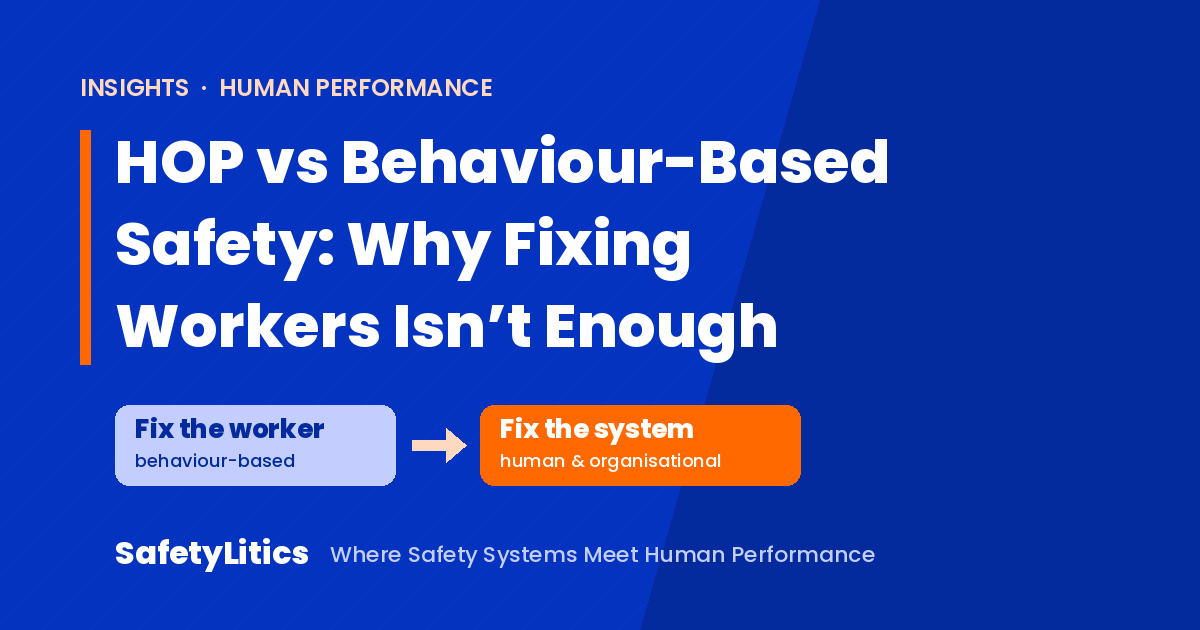
For decades, a large part of workplace safety has rested on one idea: most incidents are caused by unsafe acts, so if we change people’s behaviour, we will prevent incidents. Behaviour-based safety (BBS) programmes — observations, checklists, feedback and recognition — grew out of that idea, and many organisations credit them with real improvement.
Human & Organisational Performance (HOP) starts from a different place. It accepts that people will always make mistakes, and asks a more useful question: what in the work, the tools, the pressures and the organisation made that outcome likely?
The core difference
| Behaviour-based safety | Human & Organisational Performance | |
|---|---|---|
| Main focus | Individual worker behaviour | Systems, conditions and work design |
| View of error | Something to eliminate | Normal and inevitable — something to design for |
| Key question after an event | Who did what wrong? | Why did it make sense at the time? |
| Typical tools | Observations, feedback, reinforcement | Learning teams, error-trap analysis, capacity building |
| Risk if done badly | Blame and under-reporting | Talk without system change |
The five principles of HOP
- People make mistakes. Even skilled, careful people err. Systems should expect it.
- Blame fixes nothing. Punishing the person closest to an event rarely changes the conditions that caused it — and it drives reporting underground.
- Context drives behaviour. Time pressure, poor tools, unclear procedures and conflicting goals shape what people do.
- Learning is vital. Organisations should learn from normal work, not only from failure.
- How leaders respond matters. The reaction to bad news determines whether the next piece of bad news is reported at all.
Why behaviour change alone plateaus
BBS can reduce minor injuries, but it tends to plateau. The reason is simple: the same worker in the same flawed system will eventually meet the same error trap. Worse, if observation programmes become associated with blame, people stop reporting — and the organisation loses its best source of warning signals. Serious incidents often arise from system weaknesses that no amount of individual observation would reveal.
What HOP looks like in practice
- Learning teams in which frontline workers explain how the job really gets done, including the workarounds.
- Error-trap identification: finding the conditions — time pressure, distraction, confusing interfaces — that make mistakes likely.
- Building capacity so that when an error happens, barriers stop it from becoming harm.
- Non-technical skills such as communication and situational awareness, as developed through Crew Resource Management in aviation and high-hazard industries.
Do you have to choose?
No. Many organisations keep useful elements of observation programmes — conversations in the field, positive recognition — while reframing them through a HOP lens: the purpose of a conversation becomes understanding the work, not catching people out. The shift is less about replacing tools than about changing the question you ask.
How to start
Start small: run a learning team on a routine but difficult task, change how leaders respond to the next incident, and look for one error trap to design out. Measure whether reporting goes up — in a HOP journey, more reports are usually good news.
Learn more about our Human & Organisational Performance services, check where your culture sits with the free Safety Culture Score, or get in touch.